Planning Ahead
End-of-Life Planning Checklist: Every Decision, Document, and Login, in Order
The complete checklist, free and printable: care decisions, legal documents, the money map, digital access, funeral wishes, and who to tell. Plus the short version for when time is limited.
Most end-of-life checklists are either a legal form with no explanation, or a vague list of "talk to your family." This one is the whole job, in the order it should be done: the decisions only you can make, the documents that make them count, the money and logins your family will need, and your wishes for the end itself. It is free, it prints cleanly, and nothing on it requires a lawyer to start.
Work through it over a few evenings. If you are planning because time is short, for you or for someone you love, skip to the short version first. It is the same list, cut to the five things that cannot wait.
| Part | What it covers | Time |
|---|---|---|
| 1. Care decisions | What you want if you can't speak for yourself, and who speaks for you | 1 hour |
| 2. Legal documents | Will, power of attorney, beneficiary forms, and where the originals are | 1–2 evenings |
| 3. The money map | Every account, policy, property and debt, listed by name | 1 evening |
| 4. Digital access | Phone, email, password manager, and the legacy settings | 30 minutes |
| 5. Funeral and body wishes | Burial or cremation, the service, and what's already paid for | 1 hour |
| 6. People, pets, and the file itself | Who to call, who takes the dog, and where all of this lives | 30 minutes |
1. Care decisions: what you want, and who decides if you can't
Start here, because this is the part your family cannot do for you afterward, and the part they most dread guessing at. The National Institute on Aging's plain-English guide to advance care planning is the best free starting point if any of these terms are new.
- Healthcare proxy (medical power of attorney) named — one person, plus a backup, who can make medical decisions when you can't. Ask them first. This is the single most useful document on the page.
- Advance directive / living will written — the treatments you would and would not want: ventilator, feeding tube, resuscitation, and for how long. Free state-specific forms are available from CaringInfo; most states need only witnesses or a notary, not a lawyer.
- POLST or portable medical order, if seriously ill — a signed doctor's order that emergency crews follow, which a living will alone is not. Ask your doctor; polst.org explains which states use it and under what name.
- Where you'd want to be — home, hospice facility, hospital. Say it out loud to your proxy, then write it in the directive's comments.
- Hospice and palliative care preferences — whether you'd want comfort-focused care and at what point. Families who never heard the answer tend to choose more treatment, not less.
- Organ and tissue donation decision — recorded on your license or your state registry, and told to your proxy so nobody is surprised.
- Copies distributed — proxy, backup proxy, your doctor's office, and the front of your file. A directive nobody can find at 2 a.m. does nothing.
2. Legal documents: the paper that makes your wishes count
Our estate planning checklist walks through each of these documents one at a time and explains when you genuinely need a lawyer. Here is the checklist view.
- Will (or living trust) signed and witnessed — who gets what, and who is in charge of making that happen (your executor). Without one, state law decides.
- Executor chosen and told — and told where the will is. The most common failure is an executor who learns the job at the funeral.
- Durable power of attorney for finances — someone who can pay your bills and deal with the bank while you're alive but unable to. This one expires at death; the executor takes over then.
- Beneficiary designations checked — on every retirement account, life insurance policy, and payable-on-death bank account. These override your will, and an ex-spouse still named on a 401(k) is a real, common problem.
- Guardian named for minor children — in the will. If this is the only reason you write one, it is reason enough.
- Deeds and titles checked — how your home and vehicles are owned decides whether they pass automatically or go through probate.
- Originals in one known place — and the name of the attorney, if any, written on the front of the file.
3. The money map: what exists and where it lives
Your family does not need balances. They need to know what exists. Accounts nobody knew about go unclaimed for years; the map is the fix.
- Bank accounts — institution and type for each: checking, savings, CDs, credit union.
- Retirement accounts — every 401(k) from every old employer, IRAs, pensions, annuities. The old employer ones are the ones that get lost.
- Investment and brokerage accounts — including stock plans and any crypto, with a note on how to get in.
- Life insurance — insurer, policy number, where the policy is. Include any policy through work.
- Other insurance — health, long-term care, home, auto, and any burial or funeral policy.
- Property — home, land, vehicles; where deeds, titles and mortgage papers are.
- Debts — mortgage, cards, loans, medical bills. The full picture, so nothing is a surprise.
- Income that stops or changes — Social Security, pension, VA benefits. Survivors need to know what to file for and what to stop.
- Recurring payments — subscriptions, auto-pays, storage units. Anything that quietly charges a card every month.
- Safe deposit box or home safe — where, and where the key or combination is, and who else has access.
- Last tax return, location of — it is the map to nearly every account you own.
4. Digital access: the door families get stuck at first
A locked phone can take a court order to open, and even then Apple and Google do not simply hand over accounts. This is thirty minutes of work that saves months.
- Phone passcode written down — sealed with your papers, not taped to the phone.
- Primary email password written down — email is where every other password reset goes.
- Password manager master password — or, if you don't use one, your ten most important logins on paper.
- Apple Legacy Contact set — the official way your family gets your photos and iCloud data (Apple's instructions; our plain-English guide covers who to choose).
- Google Inactive Account Manager set — the Google equivalent (Google's instructions).
- Two-factor backup codes printed — if your phone is the second factor and the phone is locked, your family is locked out twice.
- Social media wishes — memorialize, delete, or leave alone, per account.
5. Funeral and body wishes: the argument you can prevent
Families fight hardest over what was never said. You do not need to plan the whole service; you need to answer the five questions that cause the fights. Our funeral planning checklist goes deeper, including what things actually cost.
- Burial or cremation — and, if burial, where. If cremation, what you'd want done with the ashes.
- Service or no service — religious or not, big or small, and where. "Nothing fancy" is an answer; write it down so it is honored, not debated.
- Anything already paid for — a plot, a pre-need funeral contract, a burial policy. Where the paperwork is. Pre-paid arrangements nobody knows about are paid for twice.
- Who should speak, and what music — optional, and the part families are most grateful to have.
- Obituary basics — the facts you'd want right, and anything you'd want left out.
- Budget or a ceiling — the kindest sentence in this section is "please don't spend more than X." By law, funeral homes must give you an itemized price list on request (the FTC's Funeral Rule), so a number is something your family can actually hold to.
6. People, pets, and the file itself
- The call list — family, closest friends, employer's HR (there may be benefits), your attorney and financial advisor, and the Social Security Administration (how SSA is notified). Names and phone numbers, on paper.
- Pet care plan — who takes them, the vet, any money set aside.
- Personal messages or letters — optional. Families keep these forever.
- Dependents' essentials — if you care for a child, a parent, or anyone else: their doctors, medications, routines, and who steps in.
- One place for everything — a folder, binder, or planner: findable by family, not by a burglar. The family emergency binder guide covers the storage side.
- One person told where it is. The best file in the world is worthless if nobody knows it exists.
- A yearly review date — your birthday month is easiest to remember. Update after any move, marriage, divorce, new account, or diagnosis.
The short version: if time is limited
If a diagnosis has changed the timeline, or you are doing this for a parent who is declining, the full list above is too much. These five things cannot be done by anyone else, later. Do them in this order.
- Name a healthcare proxy and sign an advance directive. An afternoon, free state forms, witnesses or a notary. If you do nothing else, do this.
- Check beneficiary forms and get the will signed. Beneficiary forms take a phone call each. A simple will can be done in days.
- Write down the phone passcode, the email password, and the list of accounts. Institution names only. Seal it with the papers.
- Say your funeral wishes out loud to one person, then write them down. Burial or cremation, service or not, a spending ceiling.
- Tell that person where the file is.
If you are the adult child doing this alongside a parent, our checklist for when a parent dies covers the weeks after, so you are not learning that part in the middle of it.
Ways to organize it all, honestly compared
Any of these work. The failure mode is not picking the wrong one; it is starting and never finishing. Prices checked September 2026.
| Approach | Cost | Good | Watch out |
|---|---|---|---|
| This page, printed | Free | Complete; nothing to buy | Checkboxes, not spaces to write in. You'll need paper alongside it |
| DIY binder (printables + office-store binder) | $15–30 | Cheapest full system; fully custom | You're the project manager; most stall half-finished |
| Fill-in planner books (Amazon) | $8–25 | Guided; ships fast | Thin paper and generic prompts are the top complaints in reviews; little on digital accounts |
| Digital vaults / apps | Free–$100/yr | Easy to update; shareable | Another login your family has to know about, the lockout problem again |
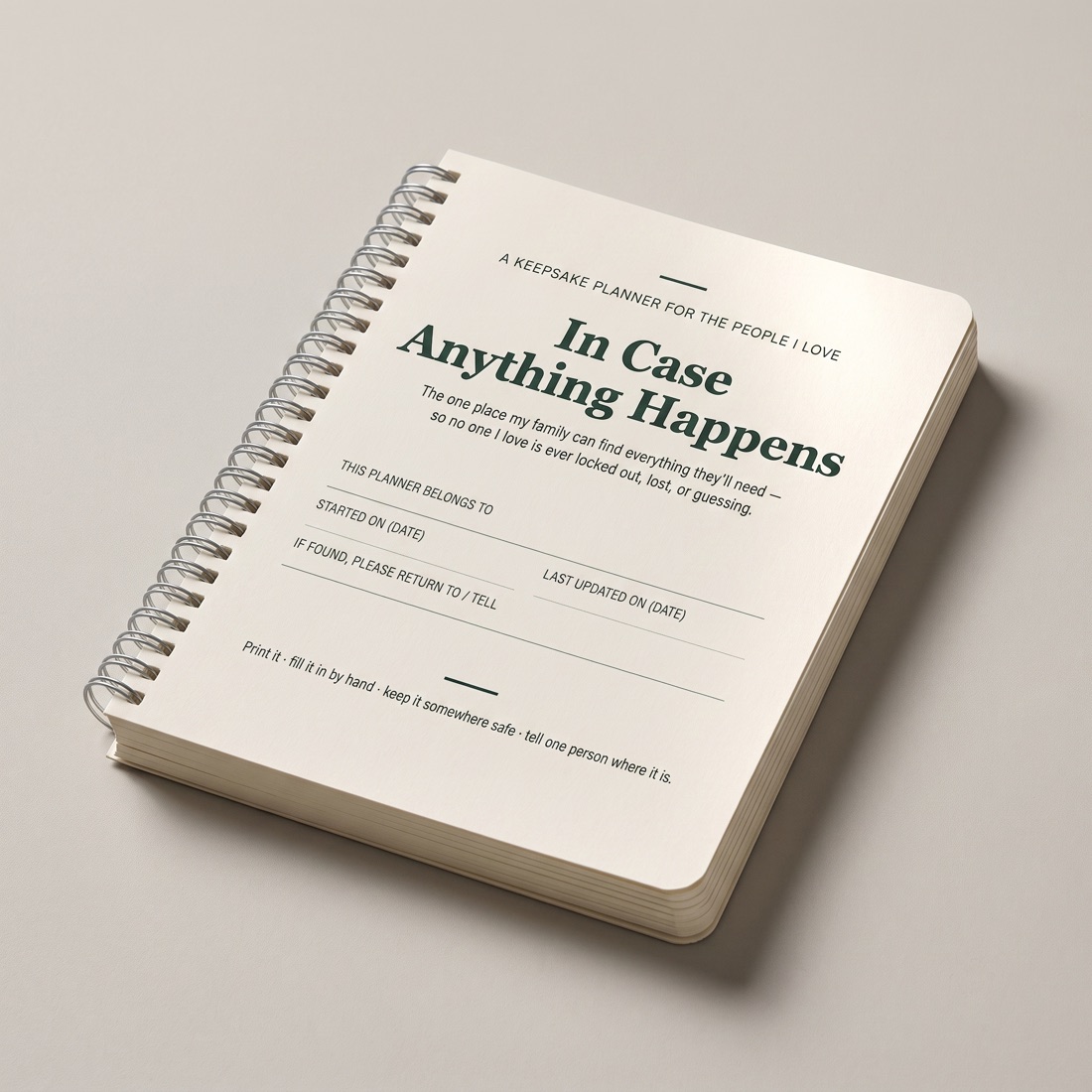
| In Case Anything Happens (this site: printed guided planner) | $59, or $89 for the two-book couples set | Guided like a book, covers every part of this page including digital, physical so there's nothing to log into | One evening of honest writing. It doesn't fill itself in |
Yes, I sell one of these. The comparison is honest anyway; for plenty of families, this page and a folder is the right answer. Pick one and finish it.
Common questions
What are the steps to prepare for the end of life?
The six parts above, in that order: care decisions and a proxy first, then the legal documents, the money map, digital access, funeral wishes, and finally the people and the file itself. Care decisions go first because they are the only part nobody can do for you afterward.
Is there a free printable end-of-life checklist?
This page is one. Press Print at the top, or use the form above. There is nothing to sign up for. If you'd rather have a PDF with space to write, the family emergency binder guide links to free printable pages for each category.
What documents do I need for end-of-life planning?
An advance directive and healthcare proxy; a will or trust; a durable financial power of attorney; current beneficiary designations; and a POLST if you are seriously ill. Then the non-legal ones that families actually need on the day: the account list, the passwords, and the call list.
Is this the same as the AARP or NIH checklist?
They cover the same ground and are worth reading; the NIA's getting-your-affairs-in-order list is the one I'd start with for the legal and medical side. What most of them skip is the digital door and the funeral conversation, which are the two places families get stuck first. This page adds those, and prints as one document.
Does this replace a will?
No. A will is a legal document; this is the practical layer around it, where things are, how to get in, who to call. Families need both. Nothing on this page is legal, financial, or medical advice.