Planning Ahead
Estate Planning Checklist for Seniors: 12 Things to Settle at 65
The age-specific list. Not the six legal documents again — the Medicare papers, the long-term-care question, the hospital-stay page, and the digital things the AARP list leaves out. Free, printable, no signup.
Every estate planning checklist for seniors I could find says the same five things: will, trust, power of attorney, advance directive, beneficiaries. They are right, and they are the same list they'd give a 35-year-old. What changes at 65 isn't the documents. It's the decisions around them — Medicare, long-term care, a hospital stay that arrives without warning, a house full of forty years of things — and the fact that the person who'll handle all of it is usually your spouse or your adult child, standing in your kitchen, trying to find a card.
So this list is organized by what changes with age, not by document type. For the six legal documents themselves — what each one does and which ones you can do without a lawyer — our estate planning checklist covers that and this page won't repeat it. One honest line first: I'm not a lawyer or a financial advisor. This is an organizer's list: what to gather, where it is, who to tell.
| # | Settle this | Why now, not later |
|---|---|---|
| 1 | Medicare and insurance papers, in one place | The first thing a hospital asks for |
| 2 | A current medication list and every doctor | The second thing they ask for |
| 3 | A healthcare proxy and an advance directive | Only you can sign these, and only while you can |
| 4 | A durable financial power of attorney | Without it, a spouse can't touch an account in your name alone |
| 5 | The beneficiary on seven accounts | The form on file can matter more than the will |
| 6 | The will — signed, and findable | Most people have one from decades ago that names the wrong people |
| 7 | How long-term care would be paid for | Medicare doesn't cover it |
| 8 | The hospital-stay page | Someone else runs your house tonight |
| 9 | Digital access: the 8 things the AARP list leaves out | A locked phone stops everything else |
| 10 | What's on autopay | Bills keep paying, and keep charging, without you |
| 11 | The house: how it's titled, and the things with a story | Downsizing is easier with a list than with a dumpster |
| 12 | Tell two people, and put a date on it | A plan nobody can find is not a plan |
The frame for all twelve is the same: before, not after. A hospital stay at 70 is the moment most families discover the plan was never finished — and it's the one moment nobody can finish it, because the person who knows where everything is is the one in the bed.
1 & 2 — The Medicare and insurance papers, and the medication list
This is the section no estate planning list has, because it's not "estate." It's the first twenty minutes of any hospital admission, and it's the part your family will be asked for while you're not able to answer. Six papers, one folder, at the front of everything else.
- Medicare card — the red, white and blue one. Medicare.gov's advice is to keep it somewhere safe and to treat the Medicare Number like a credit card number: it's unique to you and is not your Social Security number. If it's lost, a replacement comes from your Medicare account or 1-800-MEDICARE (1-800-633-4227). (Medicare.gov, checked September 2026.)
- Medicare Supplement (Medigap) or Medicare Advantage plan card — whichever you have. Families routinely hand over the Medicare card and not this one, and then get billed as if there were no plan.
- Part D drug plan card — separate again, unless it's bundled into an Advantage plan. Write on the folder which situation you're in.
- Long-term care insurance policy, if you have one — the insurer, the policy number, the agent, and the elimination period (how many days you pay before it starts). See #7 for why this matters even if you don't have one.
- A current medication list with doses — every prescription, every over-the-counter thing you take daily, and every allergy. Date it. This one line prevents more harm in the first day of a hospital stay than anything else on this page.
- Every doctor's name and number — primary care, every specialist, the pharmacy. The hospital will want to call them, and "the heart guy at the place on Main Street" is not a phone number.
Give a photocopy of the whole folder to your healthcare proxy. Not the originals — a copy, so it exists in two houses.
3 — A healthcare proxy and an advance directive
These are the two documents that only you can sign, and only while you're able to. That's the entire reason they're near the top of a list for seniors and near the bottom of most lists for everyone else. A healthcare proxy (in some states, a medical power of attorney) names the person who decides when you can't. An advance directive says what you'd want. Free state forms exist for both; our end-of-life planning checklist walks through them, and the National Institute on Aging's getting-your-affairs-in-order checklist is the government's version of the same advice.
- The proxy's name and phone number, written down where the Medicare folder is — not just in the document. The hospital needs the name in the first hour, not after someone finds the paperwork.
- A backup proxy — if your spouse is your proxy, and your spouse is the one driving you in at 2 a.m., who is the backup?
- Copies out of the house — one with the proxy, one with your doctor. A directive nobody can reach does nothing.
4 — A durable financial power of attorney
The one people skip because it feels like giving something up. Here is the practical version: if you're in the hospital for three weeks and the mortgage is paid from an account in your name only, your spouse cannot move money from it without this document. A joint account solves part of that; a durable POA solves the rest. Which accounts are joint and which are yours alone is the thing to know — write it on the list. What the document itself is and when a lawyer is worth it is on the estate planning checklist.
5 — The beneficiary on seven accounts
A beneficiary designation is the form on file with the bank or insurer that says who gets the account. On most of these accounts, that form controls, not the will. At 65 the common problem is not a missing form — it's a form filled out in 1994 that names a parent who has since died, or a former spouse. This is a check, not advice: pull each one and read the name.
- Checking account — ask the bank whether it's payable-on-death, and to whom
- Savings account — same question
- Brokerage account — transfer-on-death, and to whom
- IRA — primary and contingent (the backup)
- 401(k) or pension — including the one from an employer you left twenty years ago
- Life insurance — every policy, including small old ones and any group policy through a former job
- Annuity, if you have one
Print the confirmation page for each and put it behind the Medicare folder. The estate planning checklist explains why the form overrides the will; this page just asks you to look at the name.
6 — The will: signed, current, and findable
Most people over 65 have a will. The question is whether it's the will from 1988 that names a guardian for children who are now 45 and an executor who has since retired to another state. Three checks:
- Is the executor still the right person, and do they know? Ask them. People are named without being told.
- Is the signed original findable? "With the lawyer" is fine if the lawyer's name and number are written down and the firm still exists.
- Does it match the beneficiary forms? Where they conflict, the forms usually win — see #5.
A note on trusts, because it's the question that comes up most: whether to put a house in a trust is a question for an estate attorney in your state, and this page won't pretend otherwise. What belongs on an organizing list is simpler — if a trust exists, where are the documents, who is the successor trustee, and do they know.
7 — How long-term care would be paid for
This is a decision, not a document, and it's the one most families have never talked about. The fact that makes it urgent: Medicare does not cover long-term care. Medicare.gov says it directly — long-term care, also called custodial care, is "not covered; you pay all costs" (Medicare.gov, checked September 2026). Which leaves four ways it gets paid, and your family should know which one you're counting on:
- A long-term care insurance policy — if so, it's in the folder from #1
- Savings or home equity — and if so, which account, and who can reach it (see #4)
- Medicaid — eligibility rules are state-specific and time-sensitive; a lawyer question, but "we'd be relying on Medicaid" is a sentence your family should have heard from you
- Family — an adult child's house, an adult child's time. If that's the plan, they should have agreed to it out loud.
Write the answer in one sentence on the checklist. The sentence matters more than the amount.
8 — The hospital-stay page
Every other list on this page assumes you'll be around to explain things. This page is for the night you aren't. It's one sheet, written to whoever will be standing in your kitchen at 9 p.m. after driving home from the hospital, and it answers the eight questions they'll have by tonight.
- Who has a house key — a neighbor, a child, under the pot? Name the person.
- Who feeds the pet — and what, and how much. The most-forgotten line, and the most urgent.
- Which bills are on autopay and which you pay by hand — so nothing lapses in week two (the full list is #10)
- Mail and packages — where the mailbox key is, whether anything is expected
- The medication list and the pharmacy — a pointer to the folder from #1, so they can bring it to the hospital
- The healthcare proxy's name and number — the person the hospital will ask for
- Where the binder or folder is — the physical location, in plain words: "grey box, bottom of the hall closet"
- Who to call first — one name, one number, the person who knows your life well enough to help
That's the whole page. It takes fifteen minutes, and it's the fill-in sheet in the free printable below. If you only finish one item on this list, finish this one.
9 — Digital access: the 8 things the AARP list leaves out
AARP's guides and the AARP Foundation's estate planning kit are good on the legal documents. Where they're thin is the layer that didn't exist when most of their readers wrote their first will: the phone, the passwords, and the account that receives every "we texted you a code." A family with a signed will and a locked phone is stuck. Eight things:
- Your phone passcode — the single most valuable line, because two-step codes arrive there. Keep it with one trusted person, or sealed with the papers, and update it when you change it.
- Apple Legacy Contact or Google Inactive Account Manager — set in advance; nobody can add one afterward. Apple's process needs the access key you generate when you choose the contact plus a death certificate, and requires iOS 15.2 or later (Apple Support, checked September 2026). We wrote a whole guide to Legacy Contact on iPhone. Print the access key and put it with the will.
- The password manager's master password — which manager, and how your person is meant to get in (most have an emergency-access feature). Not the individual passwords; just the door.
- The device that gets the two-step codes — usually the phone, sometimes an old one in a drawer. Name it.
- The email recovery phone number — email is the master key to every password reset, and the recovery number is the key to email. If it's a landline you cancelled, fix that today.
- Autopay subscriptions — the ones tied to a card, listed by name (see #10)
- The photo library — where the family photos actually live (phone, cloud, an old laptop), and how someone else gets to them
- Social accounts — memorialize, close, or leave alone. Facebook supports a legacy contact of its own.
One rule for all eight: write down where the access is, not the passwords themselves. A list of passwords in a folder is a security problem in a house that will be full of visitors. Pointers, not keys.
10 — What's on autopay
Bills on autopay are a gift during a hospital stay and a slow leak after one. Nobody finds the $14-a-month subscription for a year. List them, by name, with which card or account they draw from:
- The ones that must not lapse — mortgage or rent, utilities, home and auto insurance, the Medigap or Advantage premium, the Part D premium
- The ones that could be paused — streaming, magazines, the gym, the app you forgot about
- Which card each one bills to — because when a card is cancelled after a death, everything on it stops, including the insurance
11 — The house: how it's titled, and the things with a story
Two very different jobs, and both get easier with a list. The first is paperwork: how the deed is titled (joint with right of survivorship behaves completely differently from sole ownership), where the deed is, and whether there's a mortgage and with whom. The second is the forty years of things in the house — the part that makes downsizing feel impossible.
- Deed location and how the house is titled — one line. If you're not sure how it's titled, the county recorder's office can tell you.
- Vehicle titles, and where they are
- Safe deposit box — which bank, where the key is, and who else is authorized on it. A box only you can open is sealed at exactly the moment it's needed.
- Storage units — still billing monthly, and forgotten
- The things with a story — the ring, the tools, the quilt, the photographs: who each should go to and why. This prevents more family arguments than the will does, and it turns downsizing from a dumpster problem into a list.
12 — Tell two people, and put a date on it
- Tell two people where the folder is — your proxy and one other. One person is a single point of failure.
- Write the review date on the front — a birthday, or the week the Medicare open enrollment letters arrive. Once a year is enough.
- Re-check #5 after any of these: a death in the family, a marriage or divorce, a move to a new state, a new grandchild.
The 65-and-over version of the six documents
For completeness — the legal documents every list agrees on, and where each is explained on this site. This page deliberately doesn't re-explain them.
| Document | What changes at 65 | Explained here |
|---|---|---|
| Will | Probably exists; probably out of date (#6) | Estate planning checklist |
| Durable financial POA | Becomes urgent the day a hospital stay does (#4) | Which need a lawyer |
| Advance directive + healthcare proxy | Only you can sign it, only while you can (#3) | End-of-life planning checklist |
| Beneficiary designations | Usually from decades ago; check the names (#5) | Why the form overrides the will |
| Trust (if any) | A lawyer question, not an organizer's — but where the papers are is yours | Estate planning checklist |
| Final wishes letter | The plain-language cover sheet for all of the above | Final wishes document |
Ways to do this, honestly compared
| Option | Cost | Good for | The catch |
|---|---|---|---|
| This page, printed | Free | Complete; start tonight | Checkboxes, not spaces to write in — except the hospital-stay page in the PDF. |
| AARP Foundation's Personal Estate Planning Kit | Free (email form) | Thorough on the legal documents; a respected name | It's a gift-planning kit — you'll hear from their fundraising. Nothing on Medicare cards, the hospital page, or the digital layer. |
| An estate attorney | Varies widely by state | The will, trust, and POA done right for your state | Does the legal documents, not the folder. You still have to do #1, #2, #8, #9 and #10 yourself. |
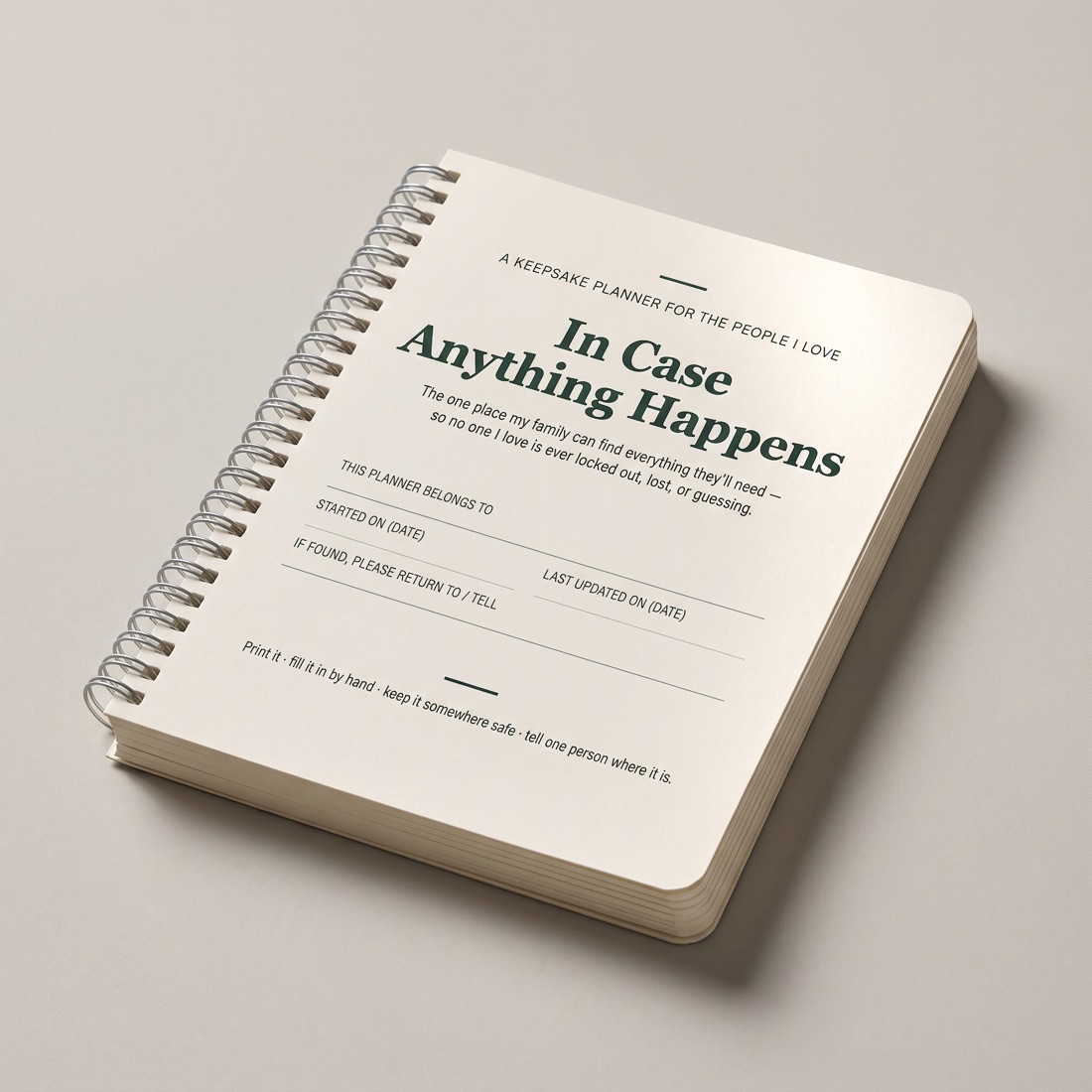
| In Case Anything Happens (this site: printed guided planner) | $59, or $89 for the two-book couples set | A prompted page for every item above, including the hospital page and the letters; nothing to log into | It's a book. Updating means crossing out and rewriting, and it costs money this page doesn't. |
The free version genuinely works. The reason people buy a printed one is not information — it's that a blank page is hard and a prompt is easy, and at 65 the blank page has been sitting there a long time.
Common questions
What should be on an estate planning checklist for seniors?
The same legal documents as any adult — will, durable power of attorney, advance directive with a healthcare proxy, current beneficiary designations — plus the things that only become urgent with age: Medicare, supplement and Part D cards in one place; a current medication and doctor list; a decision about how long-term care would be paid for; a one-page hospital-stay sheet; and the digital access your family would need. That's the twelve items above.
Is there a free printable estate planning checklist for seniors?
This page is one — press Print at the top and it prints with the checkboxes intact. There's also a free four-page PDF with the hospital-stay page as a real fill-in form. Neither needs a signup.
What does the AARP estate planning checklist leave out?
AARP's guides are solid on the legal documents. What they under-weight is the practical layer a family actually reaches for first: where the Medicare cards and medication list are, who can get into your phone and the account that receives your two-step codes, what's on autopay, and the one page someone would need to run your house during a hospital stay. Items 1, 2, 8, 9 and 10 above are that gap.
Does Medicare pay for long-term care?
No. Medicare.gov states that long-term (custodial) care is not covered and you pay all costs. That's why "how would it be paid for" is item #7 even though it's a decision, not a document.
What is the "5 by 5 rule" in estate planning?
It's a rule about how much a trust beneficiary can withdraw in a year without tax consequences. It comes up in the search results for this topic, so I'm naming it — and it's a question for a tax or estate attorney, not for an organizing checklist. If a trust exists, the organizer's question is only where the documents are and who the successor trustee is.
Should my elderly parents put their house in a trust?
That's a question for an estate attorney in your parents' state, and this page doesn't answer it. What the checklist asks is the organizational version: how is the house titled, where is the deed, and does the person who would handle it know both (#11).
I'm the adult child doing this for a parent. Where do I start?
Items 1, 2 and 8 — the Medicare folder, the medication list, and the hospital-stay page. They take an afternoon, need no lawyer, and are the three things you'll need first. Then #3, because only your parent can sign it. If a parent has already died, start instead with the checklist after the death of a parent.
Plenty of good lists exist for the legal side — the National Institute on Aging's checklist is the one I'd read next, and the National Council on Aging publishes a good one for older adults. This page is deliberately about the layer around the documents, because that's the part I watched families scramble for. Nothing here is legal, financial, or medical advice.