Planning Ahead
Final Wishes: What to Write Down, Where to Keep It, and a Template You Can Print
A final wishes document is not a will. It is the one page your family reads first. Here is what goes on it, a worked example, a free printable template, and which parts need to be made legal.
When someone dies, the family does not open the will first. The will is at a lawyer's office, or in a drawer nobody has found yet. What they reach for is a page that says, in your own words: call these people, the documents are here, this is what I want. That page is a final wishes document, and almost nobody has one.
It goes by a dozen names: letter of last wishes, letter of instruction, final wishes planner, statement of wishes. They are all the same thing. It is not a legal form, which is exactly why it is useful: you can write it tonight, on paper, with no lawyer, and it does the one job a will cannot, which is tell your family what to do in the first 48 hours.
This page has the eight things to write down, a full example, and a template you can print and fill in by hand. Nothing to sign up for. Then, near the end, the honest part: the three pieces of it that should be made legal, and how.
What a final wishes document is, and what it is not
| Document | What it does | Legally binding? |
|---|---|---|
| Final wishes document (this page) | Tells your family who to call, where things are, and what you want, in plain words | Generally no. It guides; it does not compel |
| Will | Says who gets your property and names an executor and a guardian for children | Yes, when signed per your state's rules |
| Advance directive + healthcare proxy | Your medical wishes, and who decides when you can't | Yes, when signed per your state's rules |
| Pre-need funeral contract | Locks in and usually pre-pays specific funeral arrangements | Yes, it is a contract with the funeral home |
The final wishes document is the cover sheet for the other three. It says where they are and summarizes what they say, so your family is not reading legal paper for the first time at 2 a.m. Our end-of-life planning checklist covers the full set of documents; this page is about the one you write yourself.
The eight things to write down
- Who to call first. Two or three names with phone numbers. The person who should be told first, the person who is organized, and whoever holds your documents. Include your doctor's office, your attorney if you have one, and your employer's HR line.
- Where the documents are. The will, the advance directive, insurance policies, the deed, the passwords sheet. One line each: what it is, where it physically is, who has a copy. This section alone saves families weeks.
- Your medical wishes, in one paragraph. Not the legal form, the human version: "I would not want to be kept on machines if there is no real chance of recovery. I would want to be at home if possible." Then the line: "My signed advance directive is in the folder, and [name] is my healthcare proxy."
- Body and funeral wishes. Burial or cremation. Service or none, religious or not, big or small, where. What to do with ashes. Anything already paid for and where that paperwork is. A spending ceiling, if you want to give one; it is the kindest sentence in this section. Our funeral planning checklist covers the decisions and what things cost.
- The home, the pets, the immediate practical things. Who takes the dog. Where the spare key is. Which bills auto-pay and which will bounce. Whether the car should be sold or given to someone.
- Specific gifts of personal items. Grandmother's ring to a named person, the tools to a named person. In most states a will can reference a separate list like this, but only if the will says so; otherwise treat these as requests, and say so.
- Digital accounts. What to do with your email, social media and photos: memorialize, delete, or hand over. Where the passwords are. Whether you set an Apple Legacy Contact or Google Inactive Account Manager.
- A personal message. Optional, and the part families keep forever. Two lines is enough.
An example final wishes letter
This is what a finished one reads like. It is short on purpose; a page your family will actually read beats a binder they will not.
My final wishes — Margaret R., written March 2026
Call first: my daughter Ellen (555-0142), then my brother Tom (555-0187). Ellen is my executor and my healthcare proxy. My attorney is Dana Price at Price & Lowe (555-0160).
Where things are: the blue folder in the top drawer of my desk has my will (signed 2024), my advance directive, my life insurance policy (Northwestern, policy number on the front), the house deed, and a sealed envelope with my phone passcode and passwords. Dana Price has a copy of the will. Ellen has a copy of the advance directive.
Medical: if I cannot speak for myself and there is no real chance of getting better, I do not want to be kept alive on machines. I would rather be at home with hospice than in a hospital. The signed directive says the same; Ellen decides if anything is unclear.
Funeral: cremation. A small gathering at the house, not a church. Please do not spend more than $3,000 on any of it. My ashes go in the garden under the maple. Nothing is pre-paid.
Practical: the cat goes to Ellen. The spare house key is with the neighbor, Ruth. The electric and water bills auto-pay from my checking account; the mortgage is paid off. Sell the car.
Personal items: my mother's ring to Ellen's daughter Kate. The woodworking tools to Tom. Everything else, Ellen decides; please do not argue over any of it.
Digital: delete my Facebook. Keep the photos: Ellen is my Apple Legacy Contact and can download them. Close my email after six months.
To all of you: I had a good life and I was not afraid. Look after each other.
The printable template
Press Print at the top of the page and this section prints as a fill-in sheet. Write in pen, date it, sign it, and put it at the front of your folder. Nothing on it needs a witness, though a signature and date help your family trust that it was you and that it was recent.
1. Call these people first
Name · relationship · phone. Note who is executor and who is healthcare proxy.
2. Where my documents are
Will · advance directive · insurance · deed/titles · passwords sheet. Where each is, who has copies.
3. My medical wishes, in my own words
What you would and would not want. Where you would want to be. Who decides.
4. Body and funeral wishes
Burial or cremation · service or not, where · ashes · anything pre-paid · a spending ceiling.
5. The home, pets, and practical things
Pets · spare key · auto-pay bills · car · anything that must be handled in the first week.
6. Specific items to specific people
Item → person. Note whether your will references this list.
7. Digital accounts
Email · social media · photos: memorialize, delete, or hand over. Legacy contact set? Where the passwords are.
8. A message
Signed: ____________________________ Date: ______________ This document lives at: ______________________________
The three parts that should be made legal
A final wishes document guides your family. It does not bind anyone, and in a dispute a hospital or a court will not follow it over a signed form. That is fine for most of what is on it. Three parts are different.
- Medical wishes → an advance directive and healthcare proxy. Free, state-specific forms from CaringInfo; most states need witnesses or a notary, not a lawyer. The National Institute on Aging explains the forms in plain English here. If you'd rather use a guided version, Five Wishes is a widely used one that meets the legal requirements in most states.
- Who gets what → a will (or trust). Only a will decides property. Personal-item lists work in most states if the will references them; otherwise they are requests. Our estate planning checklist covers when a simple will is enough and when you need a lawyer.
- Funeral arrangements → a pre-need contract or a funeral-agent designation. If you want specific arrangements guaranteed, a pre-need contract with a funeral home does that, and pre-pays it; read it carefully and check whether it is transferable and refundable. Many states also let you name, in a signed document, the person with legal authority over your funeral arrangements, which matters if family members might disagree. The FTC's Funeral Rule guarantees your family an itemized price list, which is what makes a spending ceiling enforceable in practice.
Where to keep it
Not in a safe deposit box. Boxes are often sealed at death until the executor is confirmed, which can take weeks; the document is for the first 48 hours. Keep it at the front of a folder or binder at home, findable by family but not by a burglar: a desk drawer, a fireproof pouch, a home safe whose combination someone else knows. Give a copy to your executor and your healthcare proxy. Then tell one more person where it lives. The family emergency binder guide is the full storage system if you want one.
Ways to do this, honestly compared
| Approach | Cost | Good | Watch out |
|---|---|---|---|
| This template, printed | Free | Done tonight; nothing to buy | One page of lines; the bigger inventory (every account, every policy) needs its own sheet |
| "Free" final wishes kits from insurers | Free, for your contact details | Usually decent worksheets | You are the lead; expect a call about final-expense insurance |
| Online template sites | Free–$40 | Fillable PDFs, state-specific | Legal-form tone; the "wishes" part often gets one line |
| Fill-in planner books (Amazon) | $8–25 | Guided; cheap | Thin paper and generic prompts are the top review complaints; little on digital |
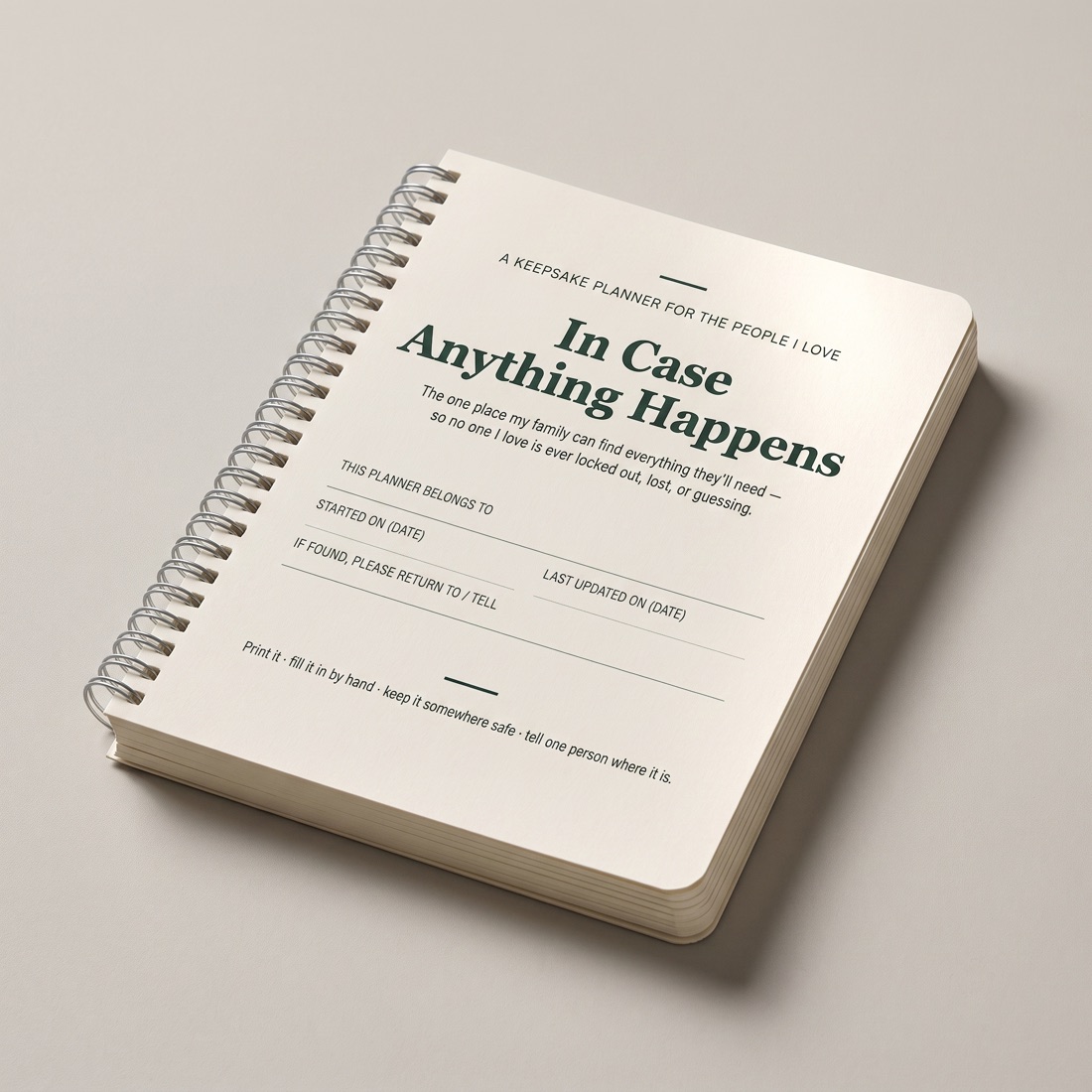
| In Case Anything Happens (this site: printed guided planner) | $59, or $89 for the couples set | The final wishes page and the full inventory in one guided book, physical so there's nothing to log into | One honest evening of writing. It doesn't fill itself in |
Yes, I sell one of these. The comparison is honest anyway; for many families, the template above and a folder is the right answer. Write the page tonight either way.
Common questions
What is the end-of-life document called?
The one you write yourself is a final wishes document, letter of last wishes, or letter of instruction. The legal ones are the will, the advance directive (sometimes called a living will) with a healthcare proxy, and the durable power of attorney. "Five Wishes" is a specific brand of advance directive that reads more like the letter than like a form.
How do I write my final wishes?
Use the eight headings above, one paragraph each, in your own voice. Write who to call, where things are, what you want medically and for the funeral, the practical things, any specific gifts, your digital accounts, and a short message. Sign and date it. It should fit on one or two pages.
Is a letter of final wishes legally binding?
Generally no, and it does not need to be. Its job is to guide. Make the medical part binding with an advance directive, the property part with a will, and the funeral part with a pre-need contract or a funeral-agent designation if your state has one. Nothing on this page is legal, financial, or medical advice.
How often should I update it?
Once a year and after any big change: a move, a marriage or divorce, a diagnosis, a new grandchild. Re-date and re-sign it so your family knows it is current.