Planning Ahead
Estate Planning Checklist: The Documents, the Access, and When You Actually Need a Lawyer
The six documents most estate plans contain, which ones you can complete with free state forms, and the step almost every guide skips — making sure your family can actually find them.
One honest sentence before anything else: I'm not a lawyer, and this page isn't legal advice. What it is: a plain-English map of the documents most estate plans contain, what each one does, which ones the National Institute on Aging says most people can complete with free state forms, and the part almost every guide skips — making sure your family can actually find and use these documents when the moment comes. That last part is organizational, not legal, and it's where most well-made estate plans quietly fail.
What "estate planning" actually means
Strip the intimidating phrase and it's three questions: who gets your things, who can act for you if you can't act for yourself, and who takes care of anyone who depends on you. An "estate" isn't a mansion — it's everything you own and owe, which means everyone has one. The documents below are just the standard answers to those three questions, written down in ways courts and hospitals recognize.
The six documents — a plain-English table
| Document | What it does | Typical DIY-ability |
|---|---|---|
| Will | Says who gets what, names an executor, and names guardians for minor children | Simple situations: often DIY-able; blended families, businesses, or conflict: lawyer |
| Living will (advance directive) | States your medical-treatment wishes if you can't speak for yourself | Yes — most states provide free forms (NIA, below) |
| Health care proxy / medical POA | Names the person who makes medical decisions for you | Yes — usually the same free state forms |
| Durable financial power of attorney | Names who can handle money, bills, and property if you're incapacitated | NIA suggests talking to a lawyer — banks are strict about these |
| Beneficiary designations | Name who directly receives each retirement account, life insurance policy, and payable-on-death account | Yes — set with each institution, free. And they override the will (below) |
| Living trust (not everyone) | Holds assets so they pass outside probate; useful for some situations, unnecessary for others | Lawyer territory |
Which of these need a lawyer — and which don't
Most guides dodge this question because the company writing them sells one of the answers. The National Institute on Aging — which sells nothing — says it plainly (NIA — Getting your affairs in order): you do not need a lawyer for advance directives — "most states provide the forms for free, and you can complete them yourself." For powers of attorney, trusts, and joint-ownership arrangements, NIA suggests you "may want to talk with a lawyer," because mistakes there surface at the worst possible time — when a bank refuses a POA or a trust wasn't funded correctly.
The medical documents are free and DIY-able today; the money documents deserve a professional's hour.
If cost is the barrier, do the free state forms this week and price a lawyer for the rest — partial protection now beats a perfect plan never.
Beneficiary designations — the document that overrides your will
Here's the fact that surprises people most: the beneficiary named on a retirement account or life insurance policy receives it directly — regardless of what your will says. A will that leaves "everything" to your spouse does not move a 401(k) still naming an ex-spouse from years ago. These designations are set institution by institution, they're free to update, and they're the most commonly outdated documents in anyone's estate. Checking them takes an afternoon of logins — divorce, remarriage, births, and deaths are the events that should always trigger it.
Why "it depends on your state" is the honest answer
Witness requirements, notarization, what makes a will valid, how POAs must be worded, whether probate is heavy or light — all of it varies by state. Any national website (including this one) that gives you a single confident answer to a state question is being tidy at the expense of being right. Two reliable ways to get your state's answer: your state's official court or attorney-general website (search "your state advance directive form" — the free forms NIA mentions are usually one search away), and your state bar association's lawyer-referral or legal-aid services if cost is a concern.
Estate tax: probably not your problem
The phrase "estate planning" drags "estate tax" anxiety behind it, so here's the IRS's own number: for deaths in 2026, a federal estate tax filing generally applies only above $15 million ($13.99 million for 2025 deaths), and in the IRS's own words, "most relatively simple estates… do not require the filing of an estate tax return" (IRS — Estate tax). A handful of states levy their own estate or inheritance taxes at lower thresholds — a state-specific question for the section above. For most families, the real risks aren't taxes: they're missing documents, outdated beneficiaries, and paperwork nobody can find.
The step everyone skips: making the documents findable and usable
Signed documents locked where nobody can reach them fail exactly when they're needed. The federal Consumer Financial Protection Bureau publishes guides for the people who will act for you — agents under a POA, trustees, guardians (CFPB — Managing someone else's money) — and the recurring theme is that helpers can only do the job if they can prove their authority and find the paperwork. The access checklist:
- Originals in one findable place — a home safe or fireproof pouch beats scattered folders. NIA's advice is exactly this: papers in one place, told to someone you trust.
- Mind the safe-deposit-box trap: a box only you can open can leave your documents sealed at the very moment they're needed — if you use one, add a co-renter or keep originals elsewhere.
- Give copies to the people named in them. Your health proxy should hold a copy of the proxy; your POA agent should know where the original is; your doctor can hold your advance directive.
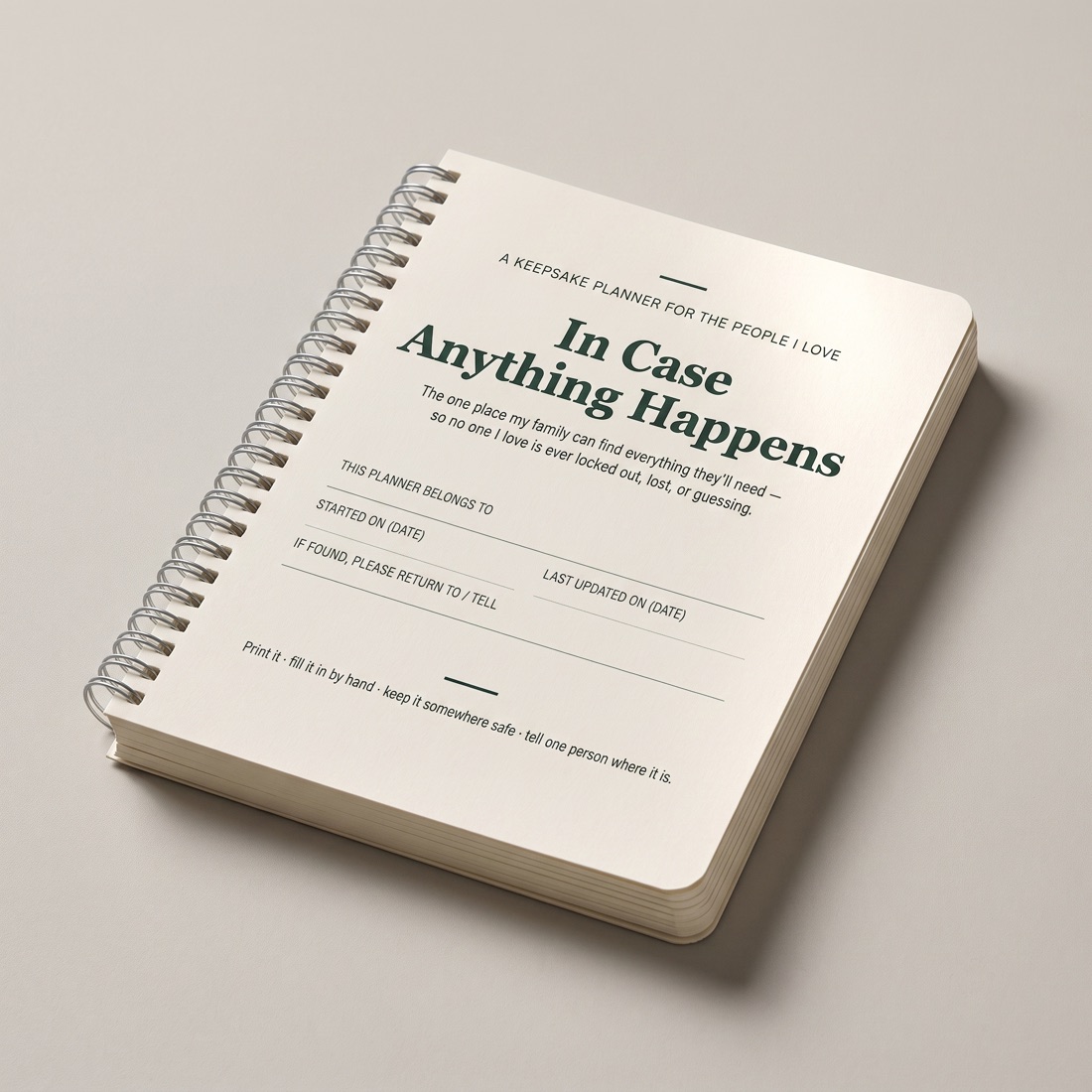
- Write down where everything lives — documents, accounts, the attorney's name — in one document your family knows about. That's the job of a family emergency binder or a guided planner; our getting-your-affairs-in-order checklist is the broader version of this page that includes accounts and passwords.
- Don't forget the digital layer: no will unlocks a phone. Apple's Legacy Contact and Google's Inactive Account Manager are the access documents of the digital world — three minutes each.
- Review on a schedule: NIA's cadence — yearly, plus after any major life change.
Common questions
Do I need a lawyer to create an estate plan?
Not for all of it. Per the National Institute on Aging, advance directives (living will, health proxy) can be completed with free state forms, no lawyer required. For wills in anything beyond simple situations, powers of attorney, and trusts, a lawyer is the safer route — those are the documents institutions scrutinize hardest.
What happens if I die without a will?
Your state's intestacy laws decide who inherits, in a fixed order set by statute — and a court chooses who administers the estate. It's slower, more public, and occasionally lands far from what the person would have wanted (unmarried partners, for example, typically receive nothing under intestacy). Even a simple valid will replaces the state's default with your actual wishes.
What is the most important estate planning document?
If forced to pick one: the will, because it's the only place to name guardians for minor children. But for many families the durable financial POA matters just as urgently — incapacity is more common than early death, and without a POA your family may need a court proceeding just to pay your bills.
What's the difference between a will and a trust?
A will takes effect at death and goes through probate; a living trust holds assets during life and passes them outside probate. Whether the trust's benefits justify its cost and upkeep is genuinely situation-specific — the kind of question worth a real attorney's hour rather than a website's paragraph.
How often should I update my estate plan?
Review yearly (NIA's cadence) and update after any big event: marriage, divorce, a birth, a death, a move to another state, or a major asset change. The most common failure isn't a missing document — it's a beneficiary form nobody looked at for fifteen years.