Planning Ahead
The Death Binder: What Goes In It, Tab by Tab
The printable death binder checklist, organized the way your family will actually use it — first hour first, personal pages last. Free, no signup.
A death binder is one folder holding everything the people you leave behind will need. Most checklists for one are sorted by category — financial, medical, legal — which is how a filing cabinet thinks, not how a grieving person thinks. This one is sorted by when. Nine tabs, in the order your family will reach for them, starting with the single page they need in the first hour.
I built a printed planner for a living, which means I have watched a lot of people try to assemble one of these. The thing that goes wrong is almost never a missing document. It is that everything is in there, unlabeled, and the person holding it has been awake for thirty hours and does not know which part is urgent. Order is the feature.
| Tab | What's in it | When they'll open it |
|---|---|---|
| 1 | The first page | Within the hour |
| 2 | Proof of who you were | Day 1–3 |
| 3 | Your wishes | Day 1–3 |
| 4 | Legal authority | Week 1 |
| 5 | Money coming in | Week 1–4 |
| 6 | Money going out | Week 1–4 |
| 7 | Property | Month 1–6 |
| 8 | Digital access | Whenever they hit a wall |
| 9 | The personal pages | When they're ready |
Build it in that order too. Tab 1 takes fifteen minutes and does more good than tabs 4 through 9 combined, because a binder nobody can navigate is a filing cabinet with a handle.
Tab 1 — The first page
One sheet of paper, at the very front, written to a person who is not thinking clearly. If you only ever finish one tab, finish this one. It should answer, in this order: who do I call, where is everything, and what happens tonight.
- Five names and phone numbers — the person in charge (your executor), your closest family, your doctor, your lawyer or accountant if you have one, and one friend who knows your life well enough to help.
- Where the original will is — the actual physical location, written in plain words. "Grey fireproof box, bottom of the bedroom closet," not "with my papers."
- Who has keys and codes — house, safe, and the alarm code. Name the person, not the code itself.
- Whether you have a prepaid or preplanned funeral — and the funeral home's name and number if so. Families routinely pay twice for a funeral that was already arranged.
- Any pets, and who has agreed to take them — the most common forgotten line, and the most urgent one in the first twenty-four hours.
- One sentence about tone — "Don't panic, nothing here is an emergency after the first day." It sounds small. It isn't.
Tab 2 — Proof of who you were
Almost every step that follows needs a certified death certificate plus proof of identity. This tab is what lets your family prove things to institutions that will not take their word for it.
- Birth certificate (certified copy)
- Social Security card or the number recorded somewhere in the binder
- Marriage certificate, and divorce decrees if any — divorce decrees matter more than people expect, because benefits and beneficiary rules turn on them
- Military discharge papers (DD-214) — required for veterans' burial benefits and a headstone
- Citizenship or naturalization papers, if applicable
- A note about death certificates — most institutions want their own certified copy and will not accept a photocopy. Order extra when the funeral director files; getting more later takes longer and costs more. If you ever need to order vital records yourself, the CDC keeps the state-by-state directory at Where to Write for Vital Records.
If you want the longer version of this tab on its own, the important documents checklist covers all ten papers and where to get each one.
Tab 3 — Your wishes
This tab exists so nobody has to guess and then feel guilty about the guess. It is the part of the binder that spares your family the most pain per page.
- Burial or cremation — stated plainly, in one line
- Any prepaid arrangements — contract, funeral home, and what it covers
- Service preferences — religious or not, who should speak, music, or explicitly "I don't care, do what helps you"
- Obituary notes — where to publish, and anything you'd want said or not said
- Advance directive / living will — for the part before, not after
- Organ and tissue donation — your registration, and whether your family knows
- Who should not be contacted — awkward to write, enormously useful
Our funeral planning checklist goes through the costs and your rights as a buyer, and the final wishes document guide has a template if you'd rather write it out longhand.
Tab 4 — Legal authority
Nothing in tabs 5 through 7 can happen until someone has legal standing to act. Put the documents that grant that standing together, in one place, near the front.
- The will — and a note saying where the signed original is, if the binder holds a copy
- Living trust documents, if you have a trust
- Durable power of attorney for finances — note that this one ends at death; it is for incapacity, not after
- Healthcare power of attorney and HIPAA release
- The name and contact of your executor, plus a backup
- Your attorney's contact, if you used one
The estate planning checklist explains each of these and, more usefully, which ones most people can genuinely do without a lawyer.
Tab 5 — Money coming in
Survivors routinely miss money they were entitled to, simply because nobody knew a policy or a benefit existed. That is the whole job of this tab: make sure no payout goes unclaimed because it was invisible.
- Life insurance policies — insurer, policy number, and agent. Include small or old policies; forgotten group policies from a former employer are common.
- Employer benefits — group life, unpaid wages, accrued leave, a 401(k), and your HR contact
- Pension or annuity details
- Social Security — a spouse may be eligible for a one-time $255 lump-sum death payment, and certain family members for monthly survivor benefits. Funeral homes generally report the death to SSA, so the family usually doesn't need to; if no funeral home is involved, the number is 1-800-772-1213. (SSA, verified September 2026.)
- Veterans' benefits — burial allowance, a national cemetery plot, a headstone and a flag, via VA burials and memorials
- Bank, retirement and investment accounts — institution names only, with account nicknames. Not full numbers. See what doesn't go in here.
- Beneficiary designations — a printed confirmation for each account. These override the will, which surprises families constantly.
Tab 6 — Money going out
The bills do not stop. Someone will have to work out what to keep paying, what to cancel, and what they are not personally on the hook for.
- Mortgage or rent — lender, and whether there's mortgage protection insurance
- Utilities — with account references, so service isn't cut off during the estate
- Loans and credit cards — institution and rough balance
- Subscriptions and auto-payments — the quiet monthly drain nobody finds for a year. List them.
- Insurance premiums still due — home and auto coverage must stay in force while the estate settles
- Taxes — your preparer's contact, and where last year's return is. A final return is usually required.
- A note on debt — debts are generally paid from the estate, and family members are not usually personally responsible unless they cosigned, held a joint account, or fall under specific state rules. The CFPB explains this plainly, and it stops collectors from frightening a grieving spouse into paying something they don't owe.
Tab 7 — Property
Slower work, months not days — but impossible without the paperwork, and the paperwork is exactly what goes missing.
- Home deed — and importantly how it's titled, because joint ownership with right of survivorship behaves completely differently from sole ownership
- Vehicle titles — cars, boats, trailers, motorcycles
- Other real estate — land, a timeshare, a rental
- Safe deposit box — which bank, which branch, where the key is, and who is authorized on it
- Storage units — the genuinely forgotten one, still billing monthly
- Items with a story — the ring, the tools, the quilt. Who it should go to and why. This prevents more family arguments than the will does.
Tab 8 — Digital access
This is the tab that did not exist a generation ago and now causes more dead ends than any other. Your family will hit a locked phone within about a day.
- Your phone's passcode — genuinely the single most valuable line in the binder, because two-factor codes arrive there. Keep it here or with one trusted person, and change the binder line when you change the code.
- Apple Legacy Contact — set it up in advance; nobody can add one later. We wrote a whole guide on how Apple Digital Legacy works and what happens if you never set it up.
- Google Inactive Account Manager — the same idea for a Google account
- Password manager — which one, and how your executor is meant to get in (emergency access, or a sealed recovery code held elsewhere)
- Email accounts — the addresses only. Email is the master key to password resets, which is exactly why the passwords don't belong on this page.
- Social media wishes — memorialize, delete, or leave alone. Facebook and Instagram both support a legacy contact.
- Anything with money in it — PayPal, Venmo, crypto, loyalty points, a business account
- Photos — where the family photos actually live, and how someone else gets to them
Tab 9 — The personal pages
Everything above is logistics. This tab is the reason people keep the binder after the estate closes, and it is the part almost nobody writes.
- A letter to each person who matters — it does not have to be long or wise. A paragraph is a gift.
- The letter of instruction — a plain, unsigned, non-legal letter explaining anything the will doesn't say: why you made a decision, what you'd want handled quietly, what not to worry about
- Family history you're the last to know — names in old photographs, where people came from, the stories that die with you otherwise
- Passwords to nothing, feelings about everything — this tab is where the binder stops being paperwork
What does not go in a death binder
Every other guide gives this one line, or skips it. It deserves a section, because a death binder has a security problem built into it: it is a book of your entire life, sitting in a house that will be full of visitors, contractors, and relatives at the exact moment nobody is watching it.
- No written passwords or PINs. Point to a password manager and a legacy contact instead. The one defensible exception is your phone passcode, because without it almost nothing else can be recovered — and even that is a judgment call about your own household.
- No full account numbers. Institution name and the last four digits is enough for your executor to find the account. It is not enough for a stranger to drain it.
- Not the only copy of the will. Keep the signed original somewhere durable and say in Tab 1 exactly where it is.
- Not your only copy of anything, if the binder lives in a bank safe deposit box. Access can be delayed after a death — ask your own bank what its policy is, then write the answer on the first page.
- No unfinished thoughts left mid-sentence. An incomplete instruction is worse than none; your family will treat it as a wish and agonize over it.
Death binder vs. emergency binder
These two get used interchangeably online and they are not the same job. Being honest about the difference: we have a separate guide to the family emergency binder, and if you're building only one, read both and merge.
| Emergency binder | Death binder | |
|---|---|---|
| For | A crisis you survive — fire, evacuation, hospital stay | After you're gone |
| Read by | You, or a spouse, with you available to explain | Someone else, with no way to ask you anything |
| Contents | Copies, insurance, medical, go-bag list | Originals' locations, wishes, authority, the personal pages |
| Lives | Somewhere grabbable on the way out | Somewhere findable and stable |
Most of the contents overlap. Plenty of people build one binder and label the sections clearly — that is a perfectly good answer, as long as the after-death sections are written to someone who cannot ask you a follow-up question.
Where to keep it, and who to tell
- One place, at home, that one person knows about. A fire-resistant box is nice. A labeled binder on a known shelf that someone can actually find beats a perfect safe nobody can open.
- Tell at least two people — your executor and one other. Telling one person means the binder disappears if you and that person are in the same car.
- Copies of the medical documents go out — with your healthcare proxy and your doctor, not only in the binder.
- Date it, and touch it once a year. Put the review date on the cover. Tax time or a birthday works; the date matters less than having one.
The one-weekend version
If the full nine tabs feel like a project you'll never start, do this instead. It takes about ninety minutes and covers most of the real risk.
- Minutes 0–15: Write Tab 1. One page. Five names, where the will is, who has keys, any prepaid funeral, the pets.
- Minutes 15–35: List every account by institution name. No numbers, no passwords. Just the names, so nothing is invisible.
- Minutes 35–50: Set your Apple Legacy Contact and Google Inactive Account Manager. Both are free and take minutes, and neither can be done by anyone after the fact.
- Minutes 50–65: Write down your funeral preference in one line, and whether anything is prepaid.
- Minutes 65–90: Write one letter to one person.
Then put the five pages in a binder, tell two people where it is, and be finished. The rest can happen across a year of evenings.
Ways to build one, honestly compared
| Option | Cost | Good for | The catch |
|---|---|---|---|
| This page, printed | Free | Complete; nothing to buy; start tonight | Checkboxes, not spaces to write in. You supply the binder and the writing. |
| DIY binder (free printables + an office-store binder and tabs) | $15–30 | Cheapest full system; completely custom | You're the designer. Most people stall at tab 3 because nothing tells them what "done" looks like. |
| Digital vault / app | $0–100+/yr | Updates easily; accessible from anywhere | Your family needs a login and the company needs to still exist. A locked account is the failure mode this whole binder is meant to prevent. |
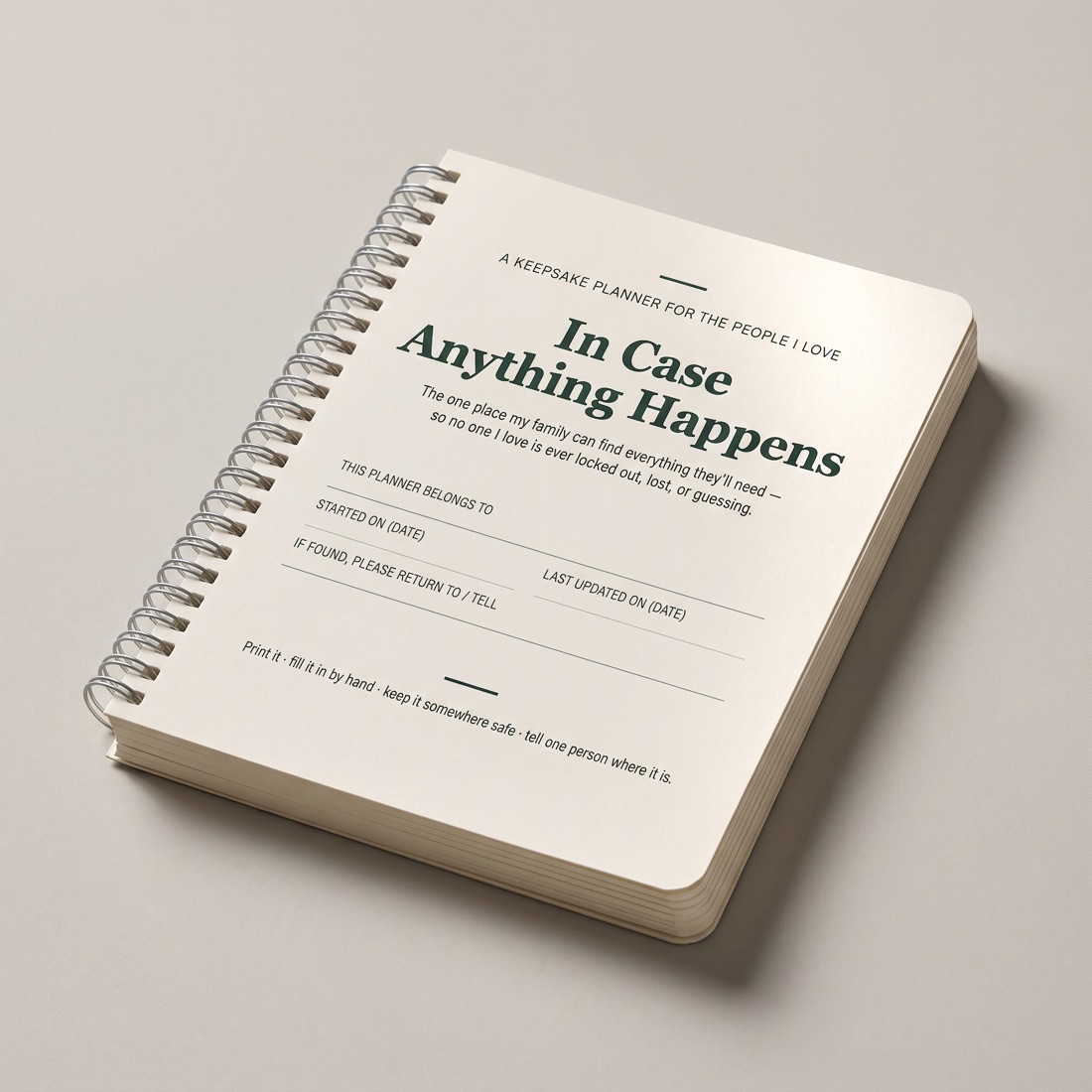
| In Case Anything Happens (this site: printed guided planner) | $59, or $89 for the two-book couples set | Guided prompts for every tab above, including the letters; nothing to log into | It's a book. Updating means crossing out and rewriting, and it costs money this page doesn't. |
The free version genuinely works. The reason people buy a printed one is not information — it's that a blank page is hard and a prompt is easy.
Common questions
What is a death binder?
A death binder is one physical folder or binder holding everything the people you leave behind will need: who to call, where the legal documents are, what you want for a funeral, what money is coming in, what bills are going out, what you own, how to reach your digital accounts, and anything personal you want to say. It is an organizing tool, not a legal document — it doesn't replace a will, and it doesn't need a lawyer or a notary.
Is an “if I die” binder the same as a death binder?
Yes. “If I die binder,” “in case I die binder,” “when I die binder” and “death binder” are four names for the same thing: one binder that tells your family what to do and where everything is. The ready-made ones sold online are mostly empty folders with printed labels; what makes one useful is what you put in it. If you only do one part, do Tab 1, the first page — it takes about fifteen minutes.
What should NOT go in a death binder?
Account passwords, PINs, and full account numbers. A binder is not a safe, and it sits in a house that will be busy and unsupervised at the worst possible time. Point to a password manager and a legacy contact instead, and keep the only copy of your will out of a bank safe deposit box where access can be delayed. Full detail in what does not go in a death binder.
Is there a free printable death binder checklist?
This page is one. Press Print at the top and it prints with the checkboxes intact, so you can tick items off on paper. There is also a free 10-page insert set designed to live inside the binder — a divider sheet for each of the nine tabs with its checklist printed on it. Neither needs a signup.
How long does it take to make a death binder?
The honest answer is ninety minutes for the part that matters and about a year for the rest, done in evenings. See the one-weekend version — Tab 1 alone takes fifteen minutes and prevents most of the real damage.
Do I need a lawyer for this?
Not for the binder. A binder is organization, not law. You may want a lawyer for what goes inside it — a will, a trust, a power of attorney — and the estate planning checklist is honest about which of those most people can do themselves and which are worth paying for.
What if someone has already died?
Then this isn't the page you need right now. Start with what to do when someone dies, which is organized by hour and week instead, or the checklist after the death of a parent.
Plenty of good lists exist — the National Institute on Aging's getting-your-affairs-in-order checklist is the one I'd read next, and Ready.gov's financial preparedness guidance covers the emergency side. This page is deliberately ordered by use rather than by category, because that is the thing that was missing every time I watched someone try to build one. Nothing here is legal, financial, or medical advice.