If You're Planning Ahead
Important Documents Binder: 8 Tabs in the Order Someone Else Will Need Them (Free Printable)
Most binders are filed the way the person who built them thinks. This one is filed the way the person who opens it — your partner, your sister, a neighbor at the hospital — will need it.
You already know where your passport is. That's the problem: an important documents binder is never really for you. It's for the day someone else has to find things in it — while you're in surgery, traveling, or just unreachable. So the order that matters isn't the order you filed it. It's the order they'll need it.
The short version — one afternoon, four things:
- A 2-inch three-ring binder, eight tab dividers, and a box of sheet protectors. That's the whole kit.
- Fill in the Start Here page first. If you stop there, you've already done the part that matters most.
- Copies in the binder, originals where they live now — and a line on each copy saying where the original is.
- Tell one person where the binder is. A binder nobody knows about is a filing cabinet.
Press Print at the top and this page prints as a checklist, no signup. One honest line first: I'm not a lawyer or a financial adviser. This is an organizer's guide — how to put the binder together and label it so a stranger can use it. It doesn't tell you which legal documents you need; our important documents checklist covers which ten papers matter. This page is about the container.
1. The eight tabs, in the order someone else will need them
Think about who opens this binder and why. Usually it's a hospital, an accident, or a trip gone wrong — not a death. In those first hours they need to know who to call and what your medications are. Your deed can wait a month. So the tabs run from urgent to eventually:
- 1. Start Here. One page: who to call first (with numbers), where the originals are, where the spare key is, and the date you last updated the binder. If they read nothing else, they read this. Section 2 has the exact lines.
- 2. Medical. Copies of insurance cards (front and back), your health care proxy, your medication list with doses, your doctors' names and numbers, allergies.
- 3. Identity. Copies of birth and marriage certificates, your Social Security card, passports, and driver's licenses. Proof of who you are is what every office asks for next.
- 4. Money. A one-page list of every account — bank, retirement, brokerage — with the institution, the last four digits, and the phone number. Not the balances, not the passwords.
- 5. Bills and debts. What auto-pays and from which account, what has to be paid by hand, and the mortgage, car loan, and cards. This is the tab that keeps the lights on while you're away.
- 6. Insurance. Life, home, auto, disability, long-term care — the company, the policy number, the phone number, and who the beneficiary is.
- 7. Property. Copies of deeds, vehicle titles, the mortgage statement, and leases.
- 8. Legal. Copies of your will, any trust, and your financial power of attorney — plus, on the front, where each original is kept and who drew it up.
Eight is enough. Most binders that fail have too many tabs, not too few: if someone has to guess between "Finance," "Banking," and "Accounts," they'll guess wrong.
2. The Start Here page — fifteen minutes, and the only page that must be perfect
Put this page in a sheet protector, in front of everything. It answers the four questions someone asks in the first ten minutes:
- Who do I call first? Two or three names, relationships, and phone numbers. Your doctor's number too.
- Where are the originals? One line each: will, deeds, titles, passports, birth certificates. "Fireproof box, hall closet, top shelf" beats "home."
- How do I get into things? Not the passwords — where they are. "Password manager; my sister is the emergency contact," or "Apple Legacy Contact is set up for Sam." Our Legacy Contact guide shows how.
- When was this last checked? A date. A binder with no date makes people trust nothing in it.
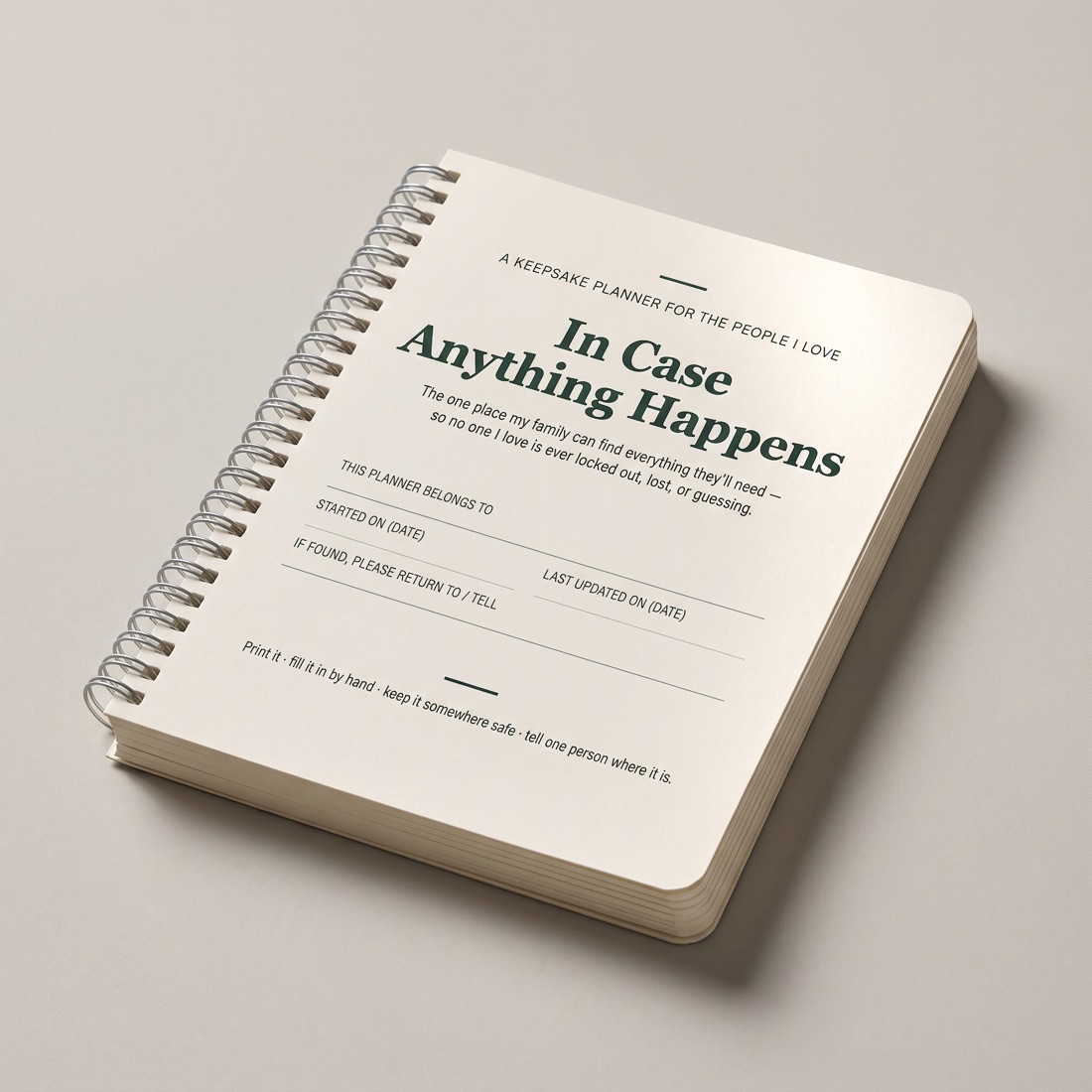
The free printable has this page ready to fill in.
3. Seven labeling rules so a stranger can use it
This is the part the organizing guides skip. A binder you understand isn't the same as a binder anyone understands. These rules close the gap:
- One cover sheet per tab, saying what's in it. "Insurance: life (2 policies), home, auto." They should know what's there before they flip.
- Date every page. Top right corner. Old statements look exactly like new ones.
- Mark each page COPY or ORIGINAL. Big letters. Nobody should have to guess whether they're holding the real birth certificate.
- Write where each original lives — on the copy itself. "Original: fireproof box" or "Original: with the attorney, Smith & Lee, 555-0142."
- A phone number beside every account. The first thing anyone does with an account is call about it.
- No abbreviations only you understand. "BofA chk" is clear to you. Write "Bank of America — checking."
- The first page tells them what to do first. That's the Start Here page. Don't bury it behind a pretty cover.
4. Six things that should NOT go in the binder
A binder that holds everything is a binder you can't leave on a shelf. Keep these out, and write where they are instead:
- Your passwords, written out in full. Write where they're kept — a password manager, a sealed envelope elsewhere — not the passwords themselves.
- The original will. Keep it where the person who drew it up told you to. The binder holds a copy and one line saying where the original is.
- Spare keys. Write where the spare key is. Don't tape it inside.
- Cash. Not even a little.
- Your Social Security card itself. A copy is enough, or just the last four digits.
- Anything you'd hate a houseguest to read. The binder sits on a shelf. Private letters go somewhere else, with a note in Start Here saying where.
If you keep the binder in a bank safe deposit box, don't make it your only copy of anything — ask your bank who can open the box and when, and write the answer on the Start Here page.
5. The ten-minute yearly check: six things to update
Pick a date you'll remember — a birthday, tax day, New Year's — and check six things:
- Beneficiaries on insurance and retirement accounts — after a marriage, divorce, birth, or death, these are the ones that get missed.
- Expired IDs and cards — passports, licenses, insurance cards. Replace the copies.
- New or closed accounts — add them to the Money tab; cross out the closed ones.
- The medication list — doses change more often than anything else in the binder.
- Emergency contacts — numbers change, people move.
- Where the originals are now — and then write today's date on the Start Here page.
The printable has a log for this, one line a year.
Which binder is which?
Four of our guides sound alike. They do different jobs:
| Guide | Its job | Use it when |
|---|---|---|
| This page | How to assemble and label the binder so someone else can use it | You're building or fixing the binder |
| Important documents checklist | Which ten documents your family needs | You're not sure what papers you have, or should have |
| Death binder checklist | What your family needs after you die, tab by tab | You're planning for that day specifically |
| Family emergency binder | What belongs in a whole-household binder, in eight categories | You want the full contents list for the household |
Ways to do this, honestly compared
| Option | Cost | Good for | The catch |
|---|---|---|---|
| A plain binder, tabs, sheet protectors + this page | About $15–25 in supplies | Doing it this weekend | You write every cover sheet yourself. |
| A ready-made document organizer (DailyDocs, Folio, fireproof accordion files) | About $20–55 | Good pockets, a nice object to keep | Mostly empty folders with labels. They hold papers; they don't tell anyone what to do first. |
| A digital folder or password manager | Free to a few dollars a month | Copies you can reach from anywhere | Someone still needs to know it exists and how to get in. Put that on the Start Here page. |
Common questions
What tabs should an important documents binder have?
Eight, in the order someone else will need them: Start Here, Medical, Identity, Money, Bills and debts, Insurance, Property, Legal. Section 1 says what goes in each.
How do I label it?
A cover sheet per tab, a date on every page, COPY or ORIGINAL on every page, where each original lives, a phone number beside every account, no private abbreviations, and a first page that says what to do first. Section 3 explains each.
What should not go in the binder?
Passwords written out, the original will, spare keys, cash, your Social Security card itself, and anything private. Write where those are instead. Section 4 has the list.
How often should I update it?
Once a year, about ten minutes, six things — section 5. Then date the Start Here page.
Is there a free important documents binder printable?
This page is one — press Print at the top. The free PDF adds a fill-in Start Here page and a yearly check log, and there's a no-email download link under the form.
If you want to know which papers belong in the binder in the first place, start with the important documents checklist. If you're building one for after a death specifically, the death binder checklist goes tab by tab. Nothing here is legal or financial advice.